Why Does My Dog Follow Me Everywhere? Velcro-Dog Behavior, Explained
A dog that follows you from room to room is usually showing normal pack bonding — sometimes with a breed, puppy, or anxiety reason behind it. What…
Clear, practical guides for every stage of your dog's life.
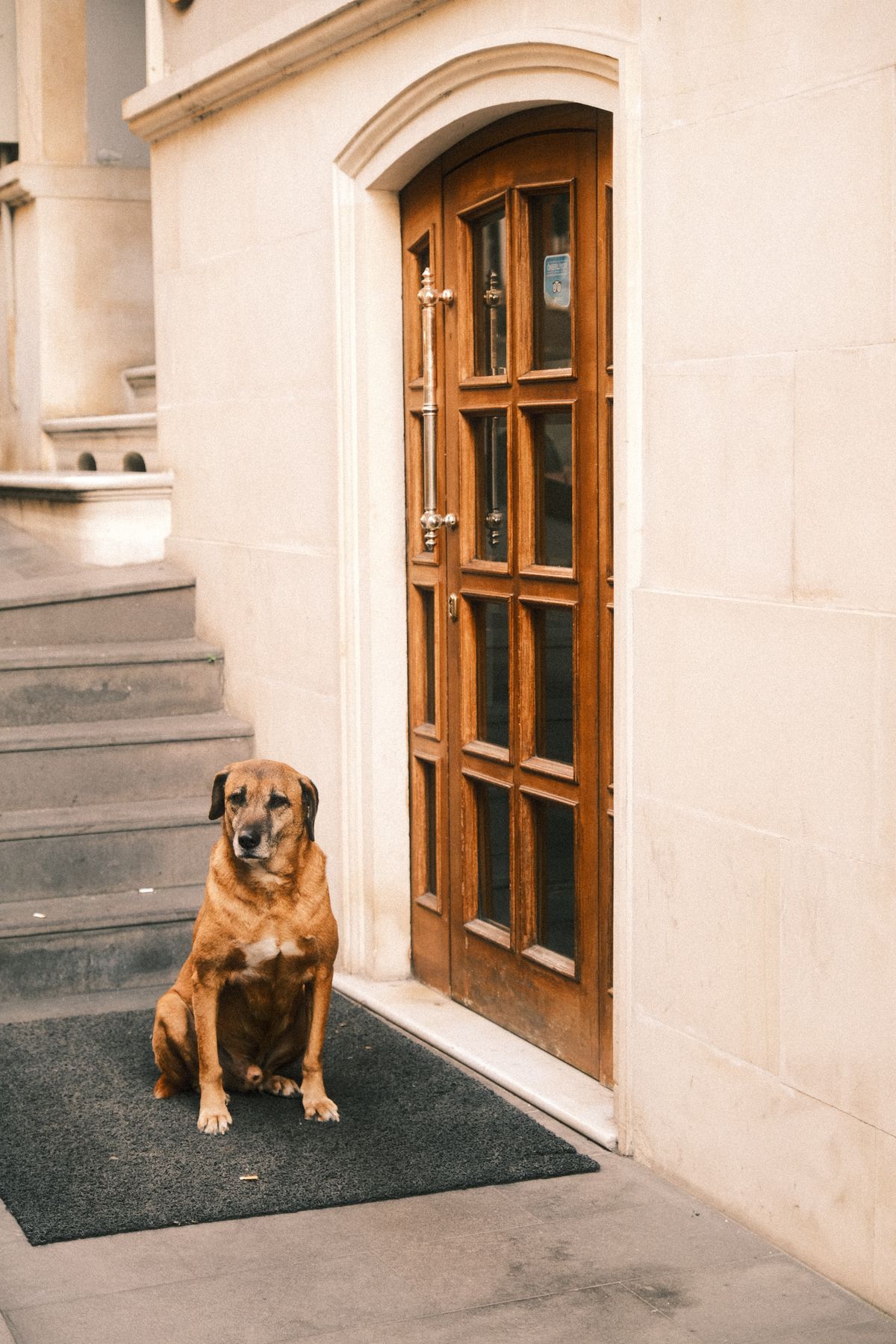
The knock lands, and your house erupts — your dog is at the door before you are, barking at full volume while you apologize over the noise. It feels like defiance; it almost never is. Door barking is usually several normal kinds of barking stacked together — an alert, a territorial announcement, an excited hello — then strengthened daily by a routine that has always paid off. The ASPCA's starting point: barking serves a variety of functions, so identify its cause and your dog's motivation before you try to change it.
The short answer: dogs bark at the door because an approach triggers alert, territorial, or greeting barking — and because barking has always worked: the driver leaves, the guest comes in, the excitement peaks. You do not train it away by shouting over it. You change what the door predicts: soften the knock with low-volume practice, teach an incompatible job — go to a mat and stay — and pay for quiet until the new routine is the habit. Expect less barking, not none: the goal is to decrease, rather than eliminate, the amount of barking (ASPCA).
The ASPCA defines territorial barking as barking in response to people, dogs, or other animals within or approaching their territory — and territory starts with the area around the home. The AKC: it is natural for dogs to bark when someone is at the door. Alarm barking is the close cousin — barking at noises and sights in any context, with stiffer body language than a greeting barker, often pouncing forward an inch or two with each bark. Territorial behavior is often motivated by both fear and anticipation of a perceived threat (ASPCA) — why scolding rarely touches it: the motivation stays even if the noise briefly stops.
Same door, opposite emotion. Greeting barking, per the ASPCA, comes with a relaxed body, excitement, and a wagging tail — often with whining alongside. The AKC notes doorbell barking can be frustrating for owners and visitors, but is also stressful for the dogs themselves. Read the body: loose and wiggly means greeting; stiff and forward means alert. The plan is the same either way, but a fearful dog needs the slower version of every step.
The ASPCA's frustration-induced barking happens when a dog is in a frustrating situation — unable to reach playmates, or confined so his movement is restricted. A door is a barrier by design: the exciting person is audible, almost reachable, and unreachable. Barking at the barrier is thwarted excitement — one reason door barking sounds worse than the dog is.
This is the layer owners miss. The ASPCA: if a dog is repeatedly rewarded for barking — if it gets him what he wants — he learns to use barking to his benefit. Replay a delivery: the dog barks, the driver leaves — barking made the stranger go away, every time. A guest arrives; the dog barks; the door opens and someone greets the dog — barking made the good part happen faster. He is not stubborn; he is well trained, by accident — the same learning loop behind the shadowing in why your dog follows you everywhere.
Every step below uses rewards, not corrections — a veterinary position, not a preference. The American Veterinary Society of Animal Behavior (AVSAB), in its 2021 Position Statement on Humane Dog Training, concludes that evidence supports reward-based methods for all canine training, and reward-based learning offers the most advantages and least harm to the learner's welfare. It recommends only reward-based methods; no evidence shows aversive methods are more effective.
Every unmanaged arrival is a full-volume rehearsal. Until the new routine is solid, cut the practice: the ASPCA advises not allowing your dog to greet people at the front door — instead, train him to go to an alternate location, like a crate or a mat, and remain quiet there, and suggests removable plastic film or glass coatings to obscure the view from windows he guards. For expected visits, the AKC advises a leash or gates to keep a door-darting dog back from the door. Management is not the fix — it stops the problem getting stronger while you build it.
Start with the sound, quietly. The AKC's method uses a recorded doorbell sound from your phone, or a helper ringing the real bell, paired with high-value treats — something smelly and slow to eat, like peanut butter on a lick mat. Play it quietly while he licks the treat. When he keeps eating as it plays, flip the order: sound first, then treat. Raise the volume across days; if he erupts, drop back a level.
A dog lying on a mat cannot also be launching at the door. The AKC frames go-to-bed this way: giving your dog something to do that is incompatible with barking or scratching at the door lets you deal with deliveries and guests properly. The ASPCA's "go to your spot" sequence:
Give quiet its own cue. The ASPCA's treat-based method: let your dog bark three or four times, say "quiet" once — clearly and calmly, without shouting — then feed a steady stream of tiny, pea-sized treats while he is silent. Over several days he connects the word with the silence that pays. Then stretch the gap before treating — 2 seconds, then 5, then 10, then 20. Never pay mid-bark, and never repeat the cue louder.
Rehearse arrivals, too — drills alone fall apart at a real one. The ASPCA's mock-visit step: recruit a friend for repeated practice visits — at least 10 to 20 repetitions, with the same person leaving for 5 to 10 minutes and returning, so the routine gets boring. Sometimes the visitor is a "delivery": your dog stays on the mat, gets treats tossed to him, and never greets. Sometimes the visitor comes in and sits; only then do you release him to say hello. For real visitors, the ASPCA waits about a minute after guests are seated before releasing the dog to greet them, on a leash if jumping is likely, and advises keeping greetings low key, with a sit-and-stay at the door. Start with people he knows well.
Most door barking is normal behavior at the wrong volume; some is not. The ASPCA notes that dogs sometimes bark in response to pain, and advises a veterinary examination to rule out medical causes before working on a barking problem — especially when barking is new or suddenly worse. RSPCA South Australia agrees: have your vet check health before assuming the barking is purely behavioral. Repetitive barking at nothing obvious — the ASPCA's compulsive pattern — also earns professional help, as does barking paired with lunging or snapping. Look for a Certified Professional Dog Trainer (CPDT) or a board-certified veterinary behaviorist who works reward-based, per AVSAB.
The short version: your dog barks at the door because it is the most exciting, predictable event in his day — and barking has always been part of how it unfolds. Change the prediction (the knock means treats), give him a job that cannot be done while barking (mat, stay, wait), pay for quiet in seconds before asking for it in minutes, and rehearse arrivals until they are boring — the same one-level-at-a-time logic as our puppy-biting redirect plan.
Sources consulted: ASPCA, "Barking" (Common Dog Behavior Issues) — barking as vocal communication with distinct functions; identify cause and motivation first; the goal is to decrease, not eliminate, barking; territorial barking (response to people or animals approaching territory, which includes the area around the home), alarm barking (any context; stiffer body language, moving or pouncing forward an inch or two per bark), greeting barking (relaxed body, excitement, wagging tail, whining), frustration-induced barking (confined or unable to reach what he wants), and attention-seeking barking; repeated reward teaches a dog to use barking to his benefit; territorial behavior often motivated by fear and anticipation of a perceived threat; management for territorial/alarm barking (block views with removable film or glass coatings, do not let the dog greet at the front door, train an alternate location such as a crate or mat); the treat-stream "quiet" method (allow three to four barks, one calm "quiet," pea-sized treats, then extend the wait from 2 to 5 to 10 to 20 seconds); "Go to Your Spot" training (spot at least eight feet from the door and within sight, 10–20 repetitions, building a stay toward 30 seconds at an 8-out-of-10 success rate, adding door movement and distractions, mock visits repeated 10–20 times with the same helper, waiting about a minute before releasing the dog to greet seated guests); unmanaged practice makes alarm barking stronger; low-key greetings and a toy by the door for greeting barking; barking in response to pain — veterinary examination to rule out medical causes first; American Kennel Club (AKC), "Why Dogs Bark at the Doorbell and How to Prevent It" — desensitizing to a recorded doorbell sound or a helper ringing the bell, high-value slow-to-eat treats (peanut butter or spray cheese on a lick mat), sound-then-treat ordering; teaching "go to bed/place" as a behavior incompatible with barking or scratching at the door, over several sessions and days, phasing out the lure; the doorbell becoming the cue to go to bed and wait for a treat; a treat jar kept near the front door; safety with leashes and gates for door-darting dogs; AKC, "Why Do Dogs Bark at Each Other?" — barking as natural communication; territorial barking at the door and at passersby is natural, with the home as territory; American Veterinary Society of Animal Behavior (AVSAB), Position Statement on Humane Dog Training (2021) — evidence supports reward-based methods for all canine training, reward-based learning offers the most advantages and least harm to welfare, only reward-based methods recommended for training and behavior problems, and no evidence aversive methods are more effective; RSPCA South Australia, "Excessive barking" — barking is normal communication; establish why the dog barks first; have a veterinarian check health before assuming a behavioral cause.
This article is general information only and is not a diagnosis or treatment recommendation for your dog. If your dog's barking is new, suddenly worse, repetitive, or paired with aggression or signs of pain or distress, talk to your veterinarian or a credentialed, reward-based behavior professional.
A dog that follows you from room to room is usually showing normal pack bonding — sometimes with a breed, puppy, or anxiety reason behind it. What…
Occasional paw licking is normal grooming; constant licking has a short list of common causes, from irritation and allergies to boredom. What to…
Bite inhibition first, then no teeth on skin — a week-by-week redirect plan for puppies 8 to 20 weeks, from AKC and ASPCA guidance.